Balancing Individual vs Organizational AI for Productivity

We’ve all experienced the chorus of voices calling for AI use for productivity and organizational change.
There is great truth to this – in case you’ve been hiding in a cave: AI is changing the way we work.
Early Adopters are gonna early adopt
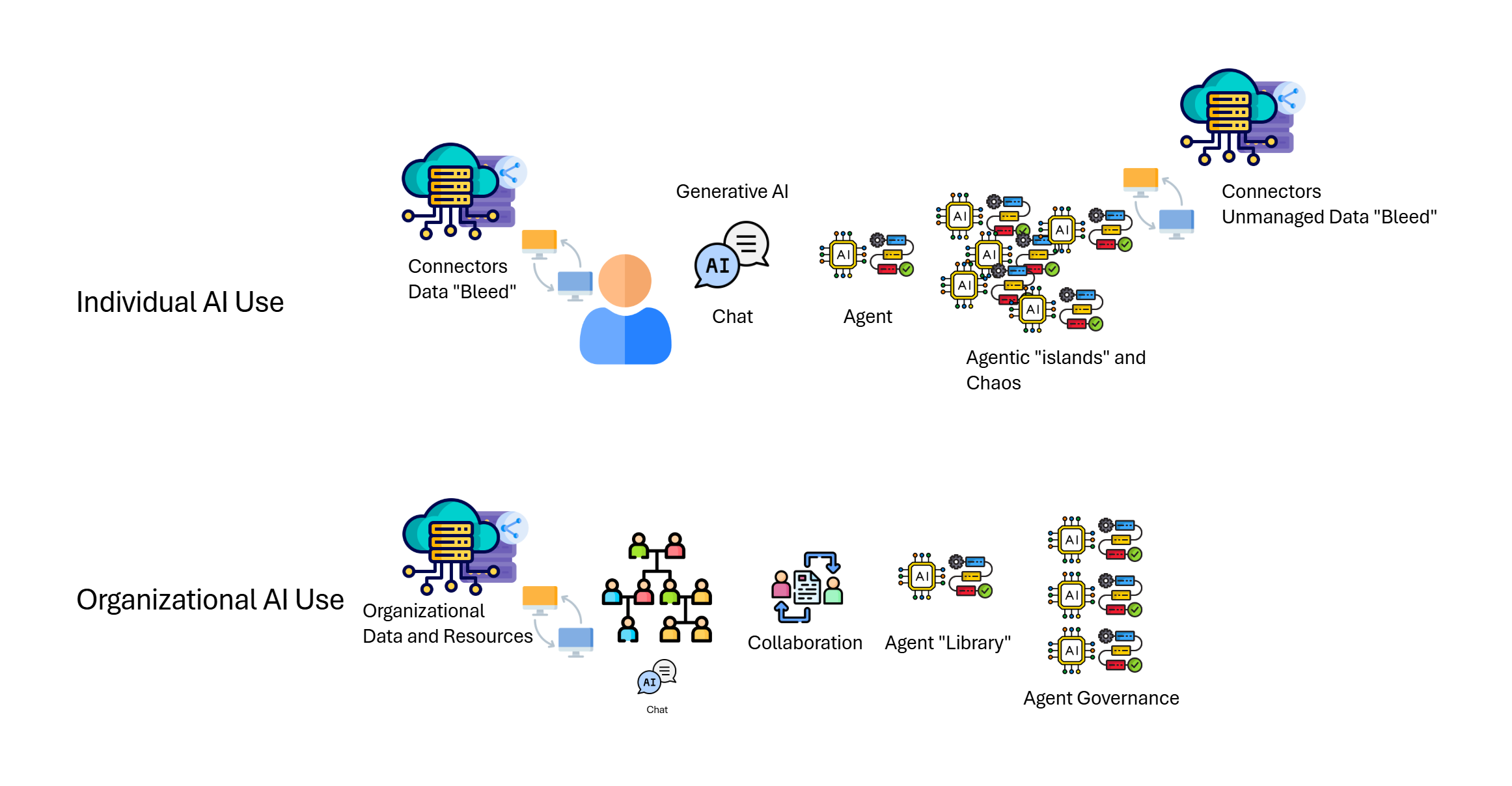
The challenge I’m seeing is that people adopting AI are using it as an individual productivity tool within an organizational context. This isn’t always the best approach if we want to protect our data, foster collaboration, and use technology for organizational improvement – as opposed to personal productivity gains.
This is not a surprise. Individuals that are motivated to adopt technology early and/or seek to gain a competitive advantage will look towards tools that they can use immediately. Generative AI ranges in price from FREE to about $200 a month for individuals. With most pro plans coming in around $20-$40 a month. An expense that many can justify.
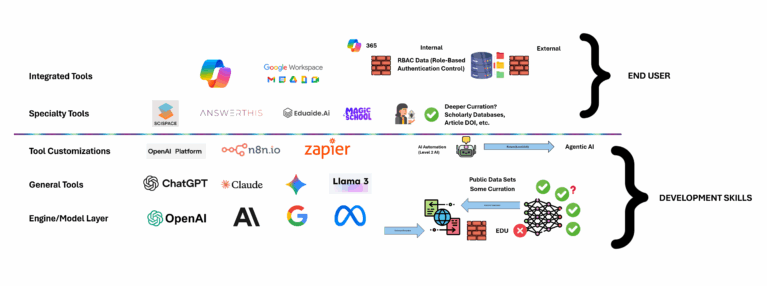
This then leads to a spread of tools within an organization where we have many people using many tools – accessing organizational documents and data.
What could possibly go wrong?
Rise of the Agents
Add to this the new fascination with Agents and (just starting – see my LiveStream for today Cowork) and we run the risk of an environment developing where we have islands of AI Agents running the halls of our organizational data! Yikes!
Agentic AI is, so some extent, an automated use of AI to accomplish workloads. Something that sounds great – but how many of your organizational workloads are:
- documented
- optimized
- isolated
This is an issue because unless we understand what we are automating, we run the risk of finding a faster way to jump off a cliff. There is an old saying in Systems Analysis: “Finding a new way to move the wrong data to the wrong place is just a faster way to cause problems.” (or something like that – it’s been awhile since I lived in that world)
We need to control our use of Agents. Not in a restrictive way (we want innovation), but in a way that protects the organization, reduces duplication, and optimizes the right processes in a collaborative way.
Organizational AI
The next “wave” of AI (in my opinion – and this is all just my opinion) is to use AI that respects organizational data boundaries and allows for governance of the processes being used.
This means that the organizational spend on AI needs to be not in providing a specific tool for a specific individual, but to provide a common solution across the organization that can be governed and optimized for purpose. That purpose with vary between organizations and even within organizations.
What Skills Are Needed?
Not AI skills… well.. yes AI Skills, but those are changing pretty fast and AI is getting better at knowing what we want without us having to “learn” AI.
I believe the next hottest career will be “AI Business Analyst” – or maybe “AI Process Analyst” – skills that focus more on understanding how to identify, document, optimize, and then apply AI to business.
Entry Level Lockout
When we think of entry-level jobs, we think of generic skills that are task-based. Something AI is replacing at a very fast pace. This is an area of great concern and conversation.
However, I would argue that the purpose of these entry-level jobs extends beyond the task-based work that was performed. These jobs had a subtext of learning how “things are done here” – they prepared the entry-level worker to “learn the ropes” of an organization and then rise to higher levels of decision-making and actions requiring better organizational understanding.
This means that if we want to prepare new entrants into the workforce, we could/should teach them not how to perform tasks, but to develop Systems Thinking skills (and that’s a broad term – it includes Critical, Creative, and other types of thinking). Lately, I’ve been playing with the term “Context Thinking”, but more on that later.
AI is cool. AI isn’t “the” answer, though. It’s the gateway into a way that we can interact with what we once called “information overload”. Let me know if you are interested in more ways to use/architect AI within an organizational (or just a more structured) context.