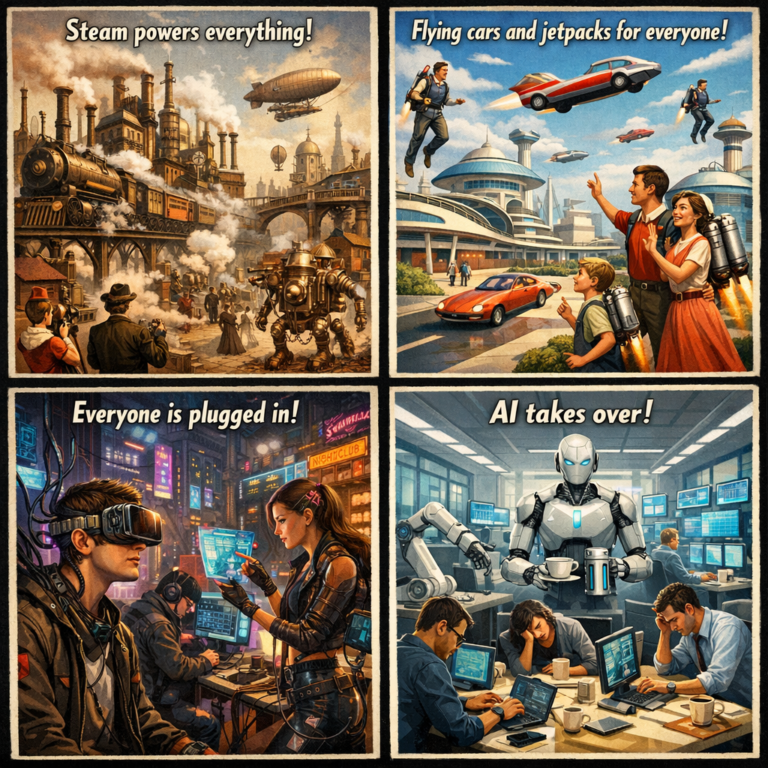
Sovereign AI: The Personal Computer Revolution Is Happening Again
Why the most important shift in AI isn’t happening in a data centre — it’s happening on your desk.
When most people hear sovereign AI, they think of governments. Data residency laws. National strategies and policy briefs. And it’s true — Canada just launched one of those, and we’ll get to it.
But that’s only the surface.
The deeper question, the one this whole conversation actually rests on, is this:
Who controls the intelligence that shapes your work?
Where does it actually live? Who decides what it remembers about you? Who decides when it’s available, what it’s allowed to say, what it costs to use, and whether it’ll still be there next year?
For most of us, right now, the honest answer is: not us.
If you’ve been paying attention to where computing has gone over the last fifty years, you’ve seen this exact pattern before. Twice. We’ve done this dance with mainframes. We’ve done it with the cloud. And we’re about to do it with AI — except this time the stakes are different. Because the thing in the middle isn’t just storage. It isn’t just software. It’s the layer that’s increasingly going to do your thinking with you.
We’re standing at a hinge moment. Here’s what I think is on the other side of it.
The Pattern: Four Eras of Computing
The history isn’t just history. It’s a pattern, and the pattern is repeating.
Era One: The Mainframe
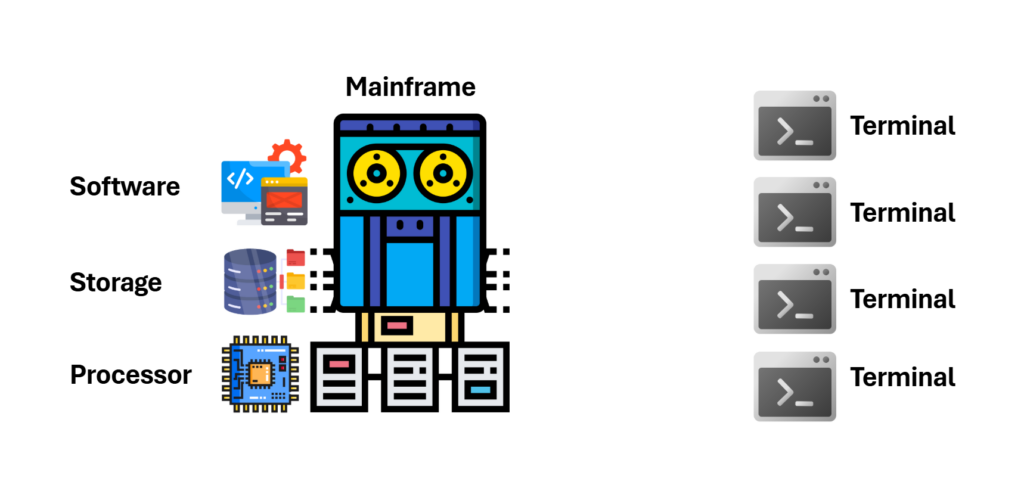
In the early days of computing, there was no such thing as a personal computer. The computer was a building. It was called a mainframe, and if you wanted to use it, you didn’t go to the mainframe — your work went to the mainframe.
You’d sit at a terminal — really just a screen and keyboard with no brain of its own — and connect to this enormous machine somewhere else. The mainframe did the thinking. The mainframe held the data. The mainframe ran the program. You were borrowing time.
This was great if you trusted the people running the mainframe. Great if it was your mainframe. But most people couldn’t afford one, so you connected to someone else’s. Often in another country, because that’s where the compute was.
If that’s starting to sound familiar, hold that thought.
In sovereignty terms: if you owned the mainframe, you had everything. If you didn’t — and most people didn’t — you had nothing.
Era Two: The Personal Computer
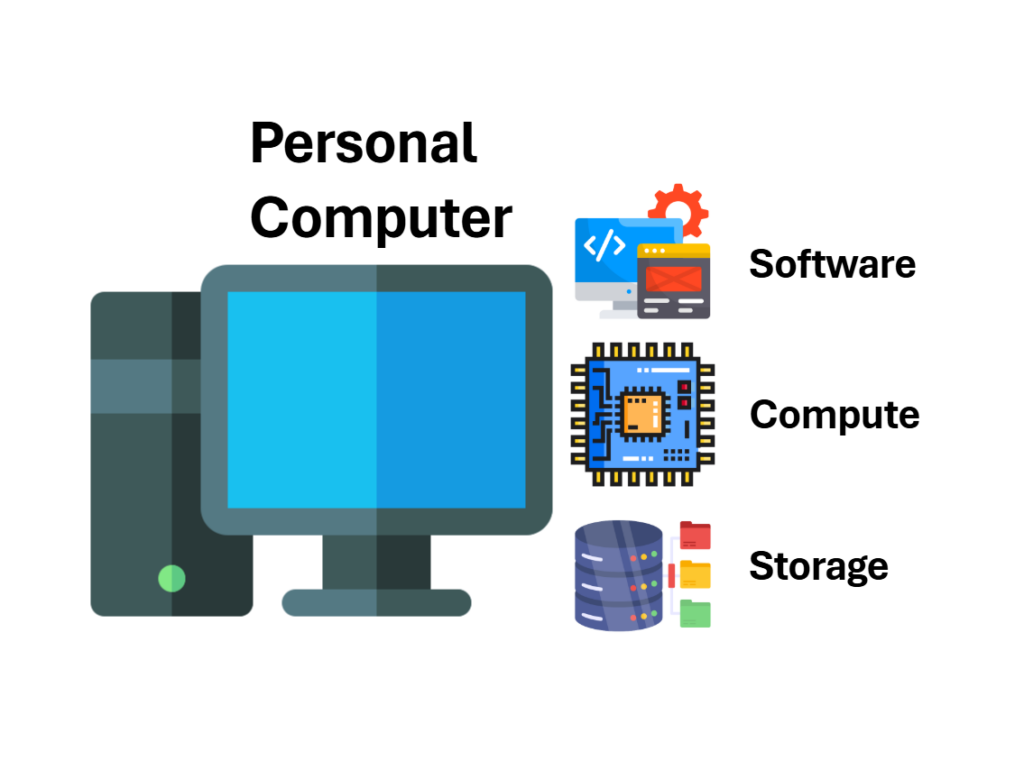
Then the PC arrived. And the early PC was a toy compared to the mainframe — you couldn’t run a bank on it, couldn’t do real scientific computing on it. The mainframes still did the heavy lifting for years.
But the PC did something the mainframe couldn’t. It put compute on your desk. The data was on your desk. The files were on your desk. The program ran on your desk.
If the power went out in the next building over, your computer didn’t care. If the company running the mainframe raised their prices, you didn’t care. If they decided you weren’t allowed to use a particular program — they couldn’t decide that, because it wasn’t their program.
This was the first time most of us experienced individual sovereignty over computing. And the principle scales: individual sovereignty for one person, organizational sovereignty for a company, national sovereignty for a country. Same principle, different scope.
Era Three: The Local Area Network
Then we figured out something else.
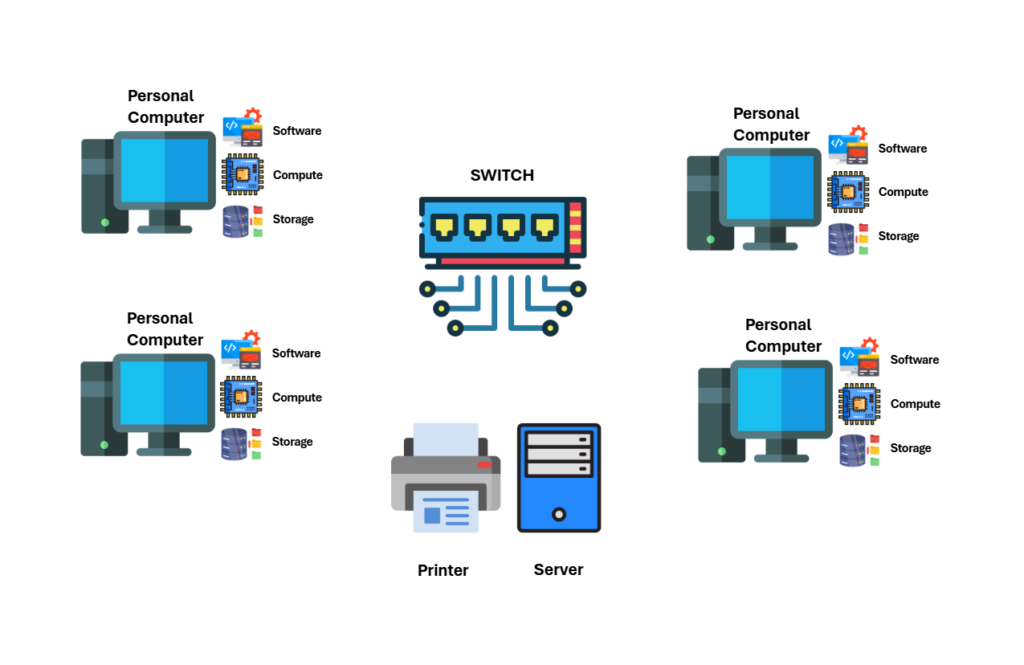
Take yourself back to the late nineties and early two-thousands. You’d have an office full of PCs, and you’d want them to talk to each other. So you ran cable — Cat 5 dropped through ceilings, run along baseboards — and at the end of all that cable everything plugged into a switch. Your PCs could see each other.
That was a LAN. Local Area Network.
You had a file server everyone could reach. A printer everyone could use. Email running on your own server, in your own building, and nobody outside the building could see it unless you let them.
Notice what just happened: we took the individual sovereignty of the PC and networked it — without giving it up. The boundary of “you” expanded from one desk to a whole organization, but the control stayed inside.
This was the era when sovereignty and connection genuinely coexisted. You weren’t an island, but you weren’t a tenant either.
Era Four: The Cloud
Then we gave it all away.
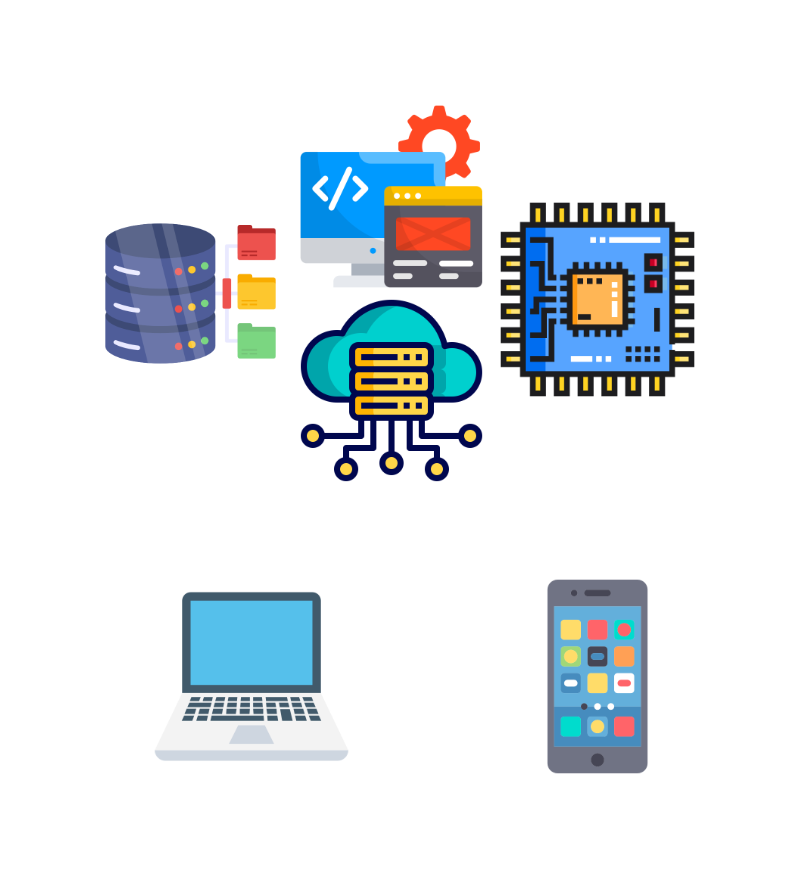
I’m being a little dramatic, because I think the cloud era deserves it. Cloud computing is genuinely amazing — global access, elastic scale, no hardware to maintain, files available wherever you are. I’m not anti-cloud. I’ve spent years of my career on cloud platforms.
But sovereignty-wise, the cloud was the great trade.
It started innocently. Mobile phones came along, low-powered devices needing somewhere to put their files. We wanted our stuff available in any office, coffee shop, or hotel room. So we put our stuff “in the cloud” — which is a polite way of saying we put it on someone else’s computer in someone else’s building.
Then it expanded. The cloud became where our software lived. Software as a service. Your spreadsheet, your email, your customer database — all of it on someone else’s machine.
For most of us, in most situations, this trade has been worth it. I’m not going to pretend my Gmail is a sovereignty crisis.
But for some organizations — legal, healthcare, defence, government — the cloud was never an option without serious caveats. Because if your data is on someone else’s hardware, in someone else’s building, possibly in someone else’s country, the question of who controls it gets very thorny very fast. So those organizations kept LANs. They paid the cost of running their own infrastructure because the alternative wasn’t acceptable.
They were right. And almost everyone else is starting to come around to their position. Because of AI.
What Sovereign AI Actually Means
Right now, when you use AI — ChatGPT, Claude, Gemini, any of the big ones — you’re doing exactly what mainframe users did sixty years ago. Your terminal is your laptop. The mainframe is a data centre somewhere, possibly not in your country, almost certainly not in your control. Your prompt goes to the data centre. The model thinks about it. The answer comes back.
This is the mainframe era of AI. We just got here.
And the same questions apply that applied in the mainframe era, plus a few new ones:
- Where is the data centre?
- Who runs it?
- What happens to your prompts and documents after you send them?
- What if the company changes pricing, or decides your use case isn’t allowed anymore?
- What if the country your model lives in has a falling-out with the country you live in?
These aren’t paranoid questions. They’re the questions every organization running critical infrastructure has to ask. They’re the questions a country has to ask if it wants its hospitals, courts, energy grid, schools, and research institutions to keep running on AI without permission from somewhere else.
So here’s a clean definition:
Sovereign AI means the model, the data, the compute, and the control all sit somewhere you trust — under jurisdiction you accept, with rules you can enforce.
That’s it. That’s the whole concept. And the principle scales:
- National sovereign AI — the data centre is in your country, run by your country’s people, under your country’s laws.
- Organizational sovereign AI — the model lives on your organization’s hardware, with your organization’s data, available to your organization’s people.
- Personal sovereign AI — the model runs on your computer, on your desk, with access to your files, and nobody else has visibility into any of it.
Same principle. Three scales.
The Canadian Moment
The timing of this conversation matters. On April 15th, 2026, the Government of Canada launched the call for applications for the AI Sovereign Compute Infrastructure Program — SCIP. About $890 million committed over seven fiscal years to build a Canadian-owned, Canadian-located, Canadian-governed AI supercomputing system.
That sits inside the larger Canadian Sovereign AI Compute Strategy, announced in Budget 2024 with $2 billion total. Three pillars:
- ~$700M to mobilize private-sector data centre investment
- ~$1B for public supercomputing infrastructure
- $300M for an AI Compute Access Fund to help Canadian companies actually use the capacity
Canada is saying — out loud, with money — that the mainframe era of AI is not where we want to live. We want sovereign capacity. Data centres on Canadian soil, running on Canadian power, governed by Canadian rules.
And Canada isn’t unique. India is doing it with Sarvam. Several European countries are doing versions of it. The UAE has been investing heavily. Every country that takes itself seriously is asking the same question: do we really want our most strategic technology to live on someone else’s machine?
That’s the country layer. Important, real, happening right now.
But it’s not the most interesting layer.
The Personal Layer: Your Computer Is Becoming Powerful Enough
While governments build data centres, something else is happening — quieter, faster, and a lot closer to your desk.
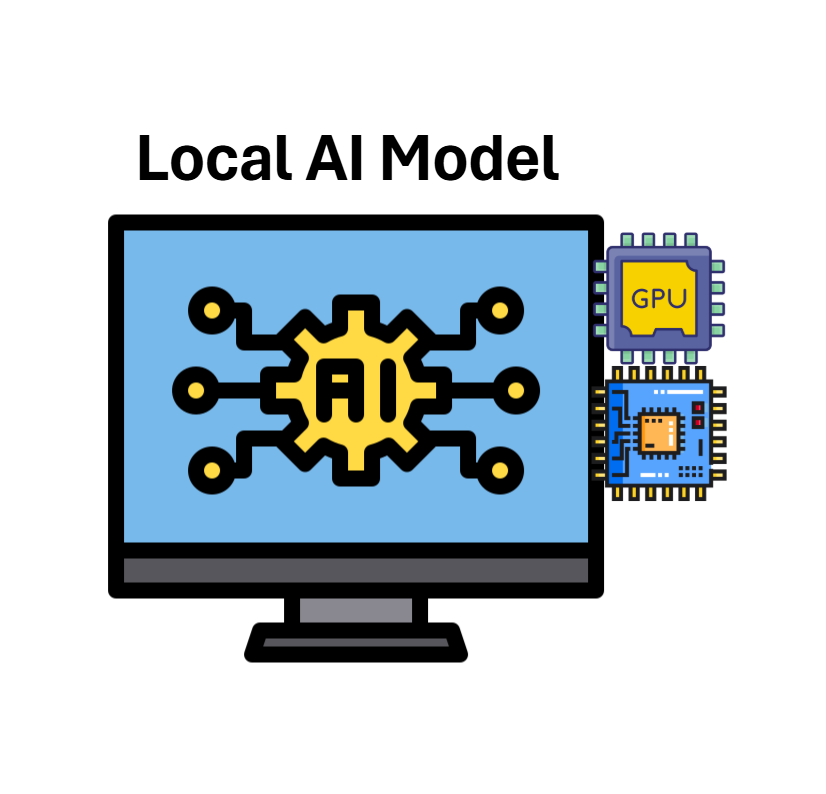
In 2026, if you have an Apple Silicon Mac with 36 GB of unified memory or more, or a recent gaming PC with a high-end GPU, or one of the new mini-PCs built around chips like AMD’s Ryzen AI Max+ 395 — you can run a real AI model locally. Not a toy. A genuinely useful 7-billion to 13-billion parameter model that handles email, summarization, writing assistance, document Q&A, code help. The tooling is mature: Ollama, LM Studio, llama.cpp install in under ten minutes.
Is the local model as smart as the frontier model in the cloud? No. The frontier model is a 500-billion parameter monster running on a billion dollars of GPUs. The local model is its 13-billion parameter cousin running on your desk.
But here’s the thing — for most of what most of us use AI for, the local model is plenty.
Organizing email. Summarizing meeting notes. Drafting messages. Pulling answers out of your own documents. Helping you think through a problem. None of that requires the frontier model. We’ve been using a Ferrari to drive to the corner store, and the corner store is two blocks away.
This is the PC revolution again. Same shape exactly. The mainframe was better at heavy lifting; the PC was good enough for what most people actually needed, and it gave you sovereignty as part of the deal. The frontier cloud model is better at heavy lifting; the local model is good enough for what most of us actually need, and it gives you sovereignty as part of the deal.
We’re at the moment when sovereignty stops being only a country-scale concern and becomes a desk-scale concern.
LAIN: The Missing Piece
When the personal computer arrived, we eventually networked it. That’s where the LAN came from. Individual sovereignty extended to organizational sovereignty without giving it up.
We have not done that for AI yet. Not properly.
You can run a sovereign AI model on your desk today. You can run a sovereign AI model on the desk next to yours. But there is no clean, mature, well-known way to network those two models together without involving someone else’s data centre.
That piece is missing. I want to give it a name, because I think naming it is part of how we get there.
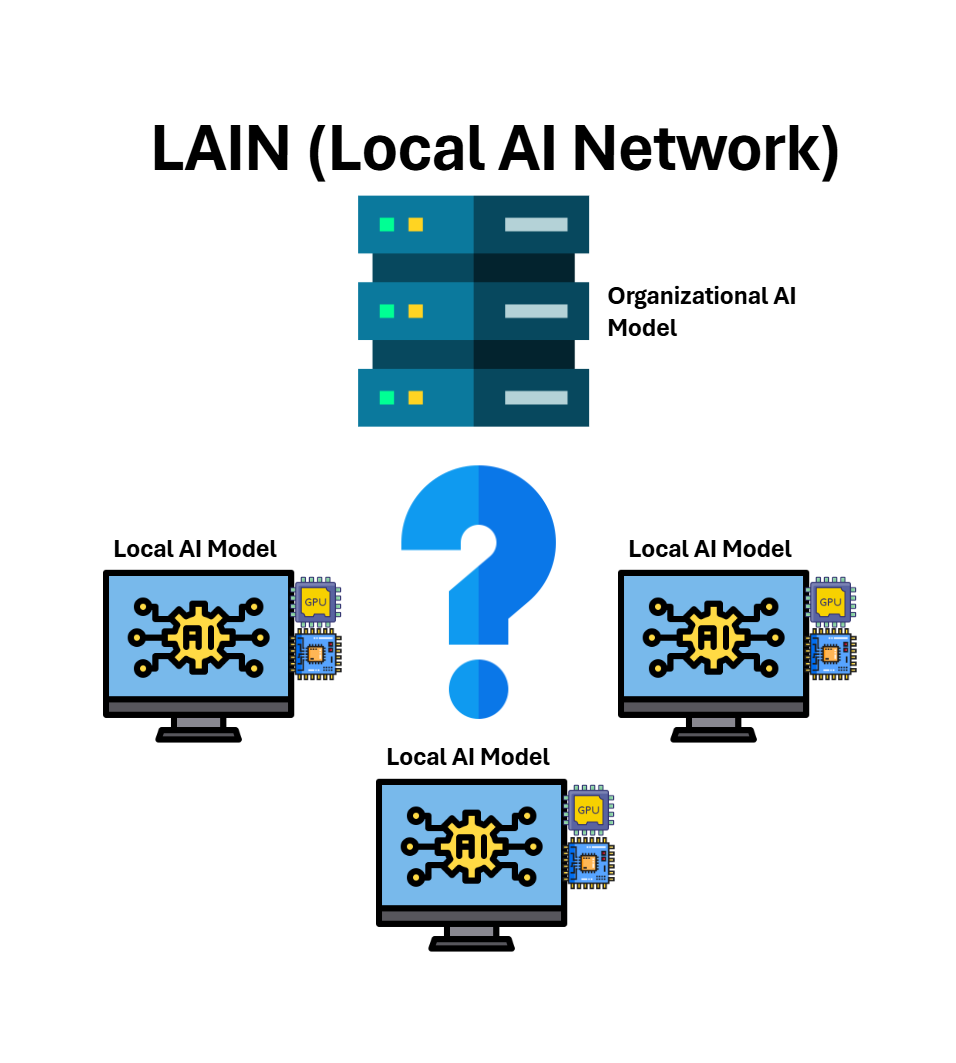
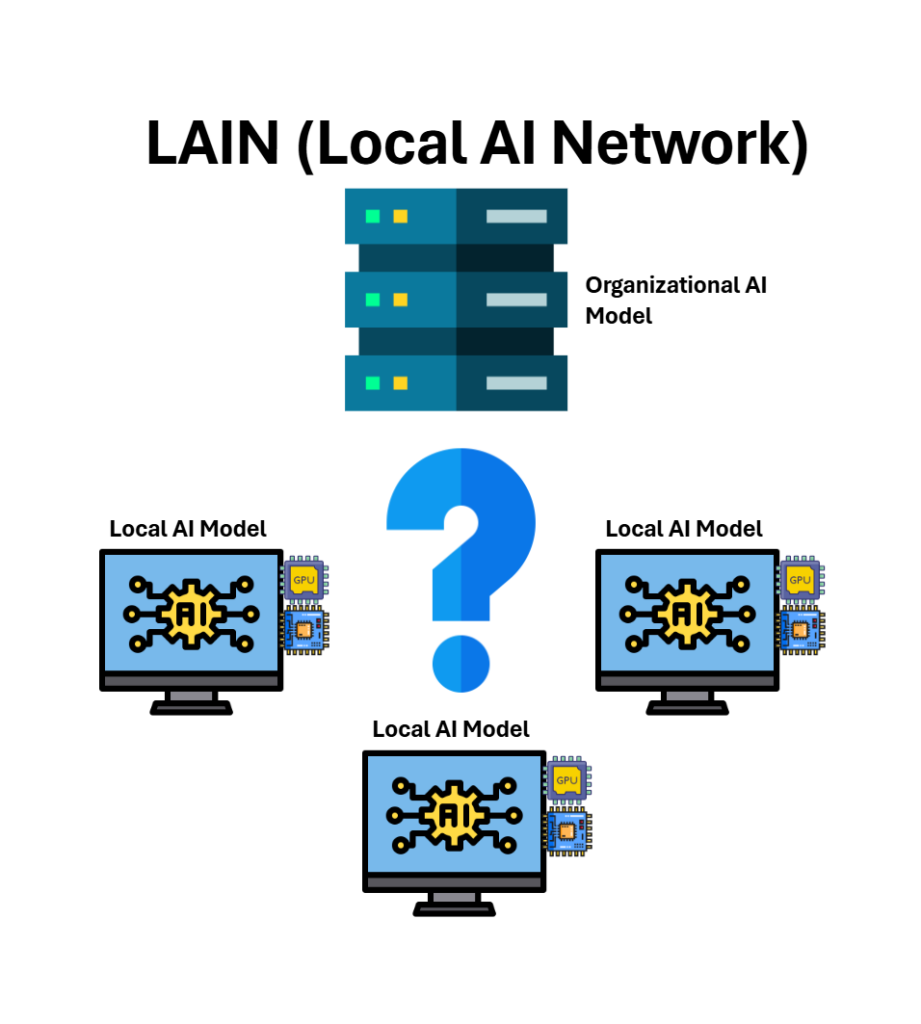
Local Area Network became LAN. So Local AI Network — let’s call it LAIN.
LAIN is what comes next.
Imagine a small organization. A clinic, a law firm, a school, a research lab. Twenty people. Each person has a computer on their desk. Each computer runs a local AI model — fine-tuned to that person’s role, pointed at their files, trained on the patterns of their work. The marketing person has a model that knows the marketing files. The legal person has a model that knows the case files. The clinician has one that’s read every note in the practice.
Now imagine those models are networked. Not to a cloud somewhere. To each other. And to a slightly larger model on a server in the building, that the whole organization shares for things that need cross-functional context.
The intelligence sits inside the building. The data never leaves. The collaboration is real. The control is total.
That’s a LAIN.
And here’s what makes me think this isn’t fantasy — every piece of it exists. Local model runtimes exist. Federated inference exists. Peer-to-peer model serving exists. Fine-tuning on local data exists. The pieces are all there. They just haven’t been put together into something a normal organization can actually deploy without a research team.
Whoever builds that — the LAIN equivalent of what Novell or Microsoft built for the LAN era — is going to do extraordinarily well. Because they will give every clinic, every law firm, every school, every small business the deal we used to have in the LAN era.
Connection without surrender. Networked intelligence with sovereignty intact.
That’s the missing layer. That’s what’s coming. I think it gets here within the next few years. The hardware is ready, the models are ready — the only thing missing is somebody making it five clicks instead of five hundred.
This is also where I think national programs like Canada’s SCIP have a real role to play. Not just hyperscale data centres for frontier models, but also helping businesses build sovereign AI inside their own walls. Both ends of the spectrum, working together.
The Takeaway
We started with a question. Who controls the intelligence that shapes your work?
Right now, for most of us, the answer is somebody else. A company in another country, on hardware in another building, under rules you don’t fully see. That’s the mainframe era of AI, and we’re living in it.
But the next era is already arriving in pieces. Countries are building sovereign data centres — Canada just put real money on the table. Hardware vendors are building chips designed for local AI. Open model communities are releasing models that run on your laptop. The personal computer revolution is happening again, this time for AI.
And after personal sovereign AI comes the local AI network. The LAN era for AI. LAIN. That chapter hasn’t been written yet, and it’s the chapter I’m most excited to watch.
Here’s the takeaway I want you to hold on to:
The next computing revolution isn’t bigger AI in someone else’s data centre. It’s your AI on your machine, networked your way.
If you want to go deeper on the personal-sovereignty version of this — how you make AI work for your thinking instead of replacing it — that’s the entire premise of my book, Learning with AI: Your Guide to Authentic, Lasting Learning. The whole book is about exactly this principle, applied to learning. It’s available on Amazon.
And one closing thought, because I genuinely believe this:
Whoever figures out how to connect personal sovereign AI models together will own the next decade.
I’m watching for them. So should you.
This post is based on the YouTube video Sovereign AI: The Personal Computer Revolution Is Happening Again. If you’d rather watch than read, the full video runs about 23 minutes and goes into more depth on each era.
If this resonated, join the conversation on Skool where we discuss educational technology, AI, and the questions that come out of videos like this one.